Schools
Arizona State University: Faculty Promotions Announced In The School Of Molecular Sciences
Arizona State University's School of Molecular Sciences recognizes and congratulates its faculty member promotions, as announced by The ...

May 28, 2021
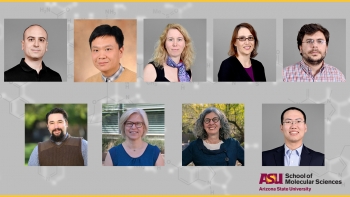
Arizona State University's School of Molecular Sciences recognizes and congratulates its faculty member promotions, as announced by The College of Liberal Arts and Sciences. These promotions will take effect in August of this year.
Find out what's happening in Tempefor free with the latest updates from Patch.
“Each promotion is well deserved and properly recognizes their hard work and dedication to their research fields, to their students and to the school,” said Ian Gould, interim director of school.
Download Full Image
Nicholas Stephanopoulos is promoted to associate professor with tenure in the School of Molecular Sciences and the Biodesign Institute's Center for Molecular Design and Biomimetics at ASU. His research includes the synthesis of novel protein- and peptide-DNA nanomaterials and their application to biology, medicine, energy and fundamental self-assembly. His work is at the interface of supramolecular chemistry, organic synthesis and bioconjugation, biology, engineering and nanoscience.
Find out what's happening in Tempefor free with the latest updates from Patch.
Wei Liu is promoted to associate professor with tenure. Liu joined the School of Molecular Sciences and the Biodesign Institute at ASU in 2015. He applies lipid cubic phase crystallization methods for studying G protein-coupled receptors, which are involved in the growth and spread of cancer, using X-ray free electron lasers (XFEL). Liu’s growing body of work now encompasses over 40 peer-reviewed publications, including 16 in Nature, Science and Cell journals with over 6,000 citations.
Marcia Levitus is promoted to full professor with the School of Molecular Sciences and the Biodesign Institute at ASU. Her research group focuses on the development and application of state-of-the-art techniques of single molecule detection to study complex biological systems, including the dynamics, structure and kinetics of nucleoprotein assemblies. Specific projects in this line of research include the study of the dynamic aspects of DNA-protein interactions in nucleosomes.
Steve Presse is promoted to full professor with the School of Molecular Sciences, Department of Physics and Center for Biological Physics. Presse uses both theory and experiments to address fundamental questions relevant to molecular science. On the theory side, Presse adapts and uses the tools of inference, statistical physics and stochastic processes, broadly defined, to understand living systems from single molecules to whole cells. A special emphasis is placed on interpreting spectroscopy and imaging data. On the experimental side, Presse investigates the role of hydrodynamics on bacterial interactions.
Anne Katherine Jones is promoted to full professor in the School of Molecular Sciences. Her research interests are in bioinorganic chemistry, energy-relevant redox chemistry and electrochemistry. Jones' group uses electrochemical methods to study the mechanisms of biological and bio-inspired redox catalysts relevant to energy production. She is a member of ASU's Center for Bioenergy and Photosynthesis. Jones’ promotion and appointment as the vice provost for undergraduate education, which begins in July, was announced last year.
Promotions announced last year in the School of Molecular Sciences include Hilairy Hartnett, who also holds a joint appointment with the School of Earth and Space Exploration; Hartnett was promoted to full professor. Alexandra Ros was promoted to full professor; Ros holds a joint appointment as a faculty member of the Center for Applied Structural Discovery at the Biodesign Institute. Gary Moore, who likewise holds an appointment with the Biodesign Center for Applied Structural Discovery, was promoted to associate professor. Jia Guo, who studies mechanisms of complex diseases, was promoted to associate professor.
The School of Molecular Sciences is part of a group awarded a JEDI — Justice, Equity, Diversity and Inclusion — seed grant from The College of Liberal Arts and Sciences at Arizona State University.
The College established JEDI seed grants to promote an environment of equity and inclusion. The School of Molecular Sciences partners with the School of Earth and Space Exploration and the School of Life Sciences on the award and the grant’s fulfillment.

Download Full Image
Christy Till, an associate professor in the School of Earth and Space Exploration, along with School of Life Sciences Professor Sharon Hall and Clinical Assistant Professor Ara Austin of the School of Molecular Sciences, were awarded $9,550 for their grant proposal, INCLUDES.
INCLUDES, which stands for “Natural Sciences INCLUsion DEpartmentS Training Program,” will provide annual workplace climate and bystander intervention trainings. These trainings aim to reduce harassment and promote cultural and racial understanding, consistent with ASU’s charter as a “public research university, measured not by whom it excludes, but by whom it includes and how they succeed.”
"I believe that we are taking a step towards creating a more inclusive environment across the natural sciences units by participating in the proposed INCLUDES training program,” Austin said. “We are excited that many of our faculty members are eager to participate in this program, and their willingness shows just how much we are taking these matters seriously."
The first INCLUDES trainers — three senior faculty each from the School of Molecular Sciences, School of Life Sciences and School of Earth and Space Exploration — will themselves be trained through the ADVANCEGeo inclusion workshops. These workshops prepare trainers for the biology, chemistry, ecology, geoscience and engineering research environments. The INCLUDES program will be self-sustaining through annual workshops for future trainers. INCLUDES trainers will then teach and mentor other faculty, postdoctoral fellows and graduate students in these units.
INCLUDES will instruct participants to recognize ways exclusionary and harmful behaviors manifest in research and educational settings, and to implement direct and indirect behaviors to stop harmful behaviors. Ultimately, INCLUDES will promote improved work and educational environments for the most valued part of ASU — its people.
This press release was produced by Arizona State University. The views expressed here are the author’s own.