Seasonal & Holidays
Hot Honey Pizza Is The Perfect Pie To Make This Valentine's Day
Famous pizza chef Ken Forkish lets us in on the secret recipe behind his signature pizza, as well as his favorite tools to help create it.


If you're looking for a last-minute gesture that will impress your sweetheart this Valentine's Day, Ken Forkish might just have the answer: Brooklyn Hot Honey Pizza Pie.
Forkish — a Portland, Oregon-based chef, restauranteur and James Beard award-winning author of "Flour Water Salt Yeast" — ever-so-kindly shared the secret recipe behind the pie that is as flavorful as it is flirty. Its combination of sweet honey and spicy chili flakes makes it the perfect dish to serve on date night.
Not only did Forkish reveal the delicious ingredients and step-by-step directions for his signature Hot Honey pizza, he also gave us the detailed recipe for crafting his famous Saturday Pizza Dough — an essential when making one of his world-class pies.
Find out what's happening in DealTownfor free with the latest updates from Patch.
Related Articles:
- It's Time To Ditch Your Germy Cutting Board
- This Little Piggy Keeps Your Microwave Clean
- 8 Must-Have Kitchen Gadgets To Perfect Your Pasta Dishes
- These Eco-Friendly Bags Take The Hassle Out Of Grocery Shopping
While Ken’s favorite kitchen tool is always the human hand, he does suggest a few other essentials for crafting the ultimate pizza, such as a pizza stone, a digital kitchen scale and a stainless steel dough scraper. Luckily, we've included some of our own handy item suggestions for your pizza-making pleasure.
Find out what's happening in DealTownfor free with the latest updates from Patch.
So now, it's time to take a page out of Forkish's cookbook, "The Elements of Pizza," and get cookin'.

"The Elements of Pizza" by Ken Forkish, $20.91
Brooklyn Hot Honey Pie
(Makes one 12-inch pizza)
Ingredients:
- 1 dough ball (See Saturday Pizza Dough Recipe, below)
- 90 grams (3 ounces) low-moisture whole-milk mozzarella
- 15 to 20 grams (¼ to ⅓ cup) Pecorino Romano cheese
- 100 grams (⅓ cup plus 1 teaspoon) tomato sauce
- 20 grams (⅔ ounces) pickled onions
- 35 grams (1 ¼ ounces) coppa or prosciutto, thinly sliced
- A drizzle of honey
- Chili flakes
Directions:
1. Preheat the oven. Put your pizza stone on an upper rack in your oven no more than 8 inches below the broiler. Preheat the oven to 550 degrees Fahrenheit for 45 minutes.
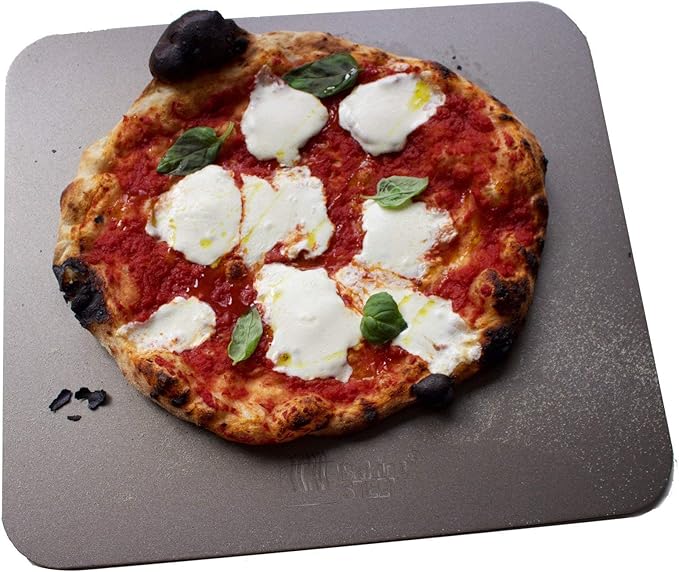
Original ultra conductive pizza stone, $89.99
2. Prep the cheese. Use a box grater’s large holes to grate the mozzarella. Use the grater’s small holes to grate the Pecorino Romano cheese.

3. Set up your pizza assembly station. Give yourself about 2 feet of width on the countertop. Moderately flour the work surface. Position your wooden peel next to the floured area and dust it lightly with flour. Have the sauce, cheese, onions, coppa and honey at hand. Switch the oven to broil 10 minutes before loading the pizza.
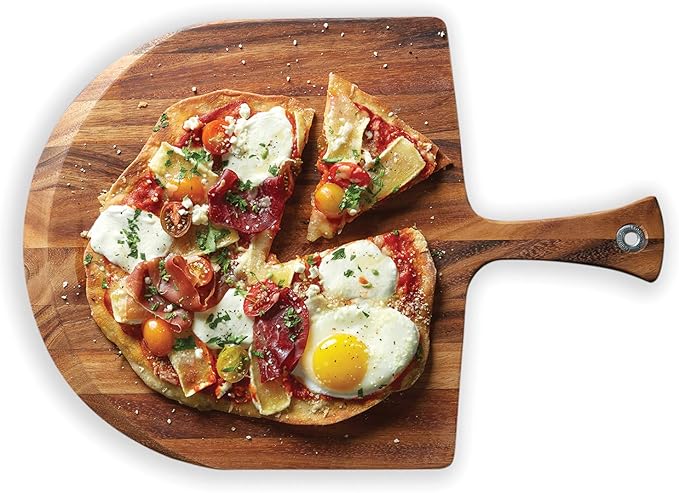
Hand-crafted wooden peel, $23.02
4. Shape the pizza. First, put the dough ball on the floured work surface and flip to coat both sides moderately with white flour. Using floured hands, grab the rim at about the 10 o’clock and 2 o’clock positions and lift so the crust hangs down vertically; preserve the outer rim by placing your thumbs about a half inch from the edge for a Neapolitan-style pizza, or a quarter inch from the edge for a New York-style pie.
Let gravity pull the rest of the dough down to stretch it. If the dough is stretching easily, I let the bottom of the dough rest on the counter while I’m turning it so I can control the speed and evenness of its expansion. Run the rim between your hands, working all the way around the circumference of the dough a couple of times. You can work as slowly as you want. If the dough gets sticky, set it down and give both the top and bottom another dusting of flour.
Next, make two fists and position them just inside the rim, with the crust still hanging vertically. Gently stretch and turn the dough repeatedly, letting the bottom of the dough pull down, expanding the surface. Keep a close eye on the thickness of the dough. There is no benefit to overstretching it — when it’s done, it’s done. You want the dough thin, but you don’t want it so thin that it tears or can’t support the weight of the toppings.
Transfer the disk of pizza dough to the peel. Run your hands around the perimeter to relax it and work out the kinks.
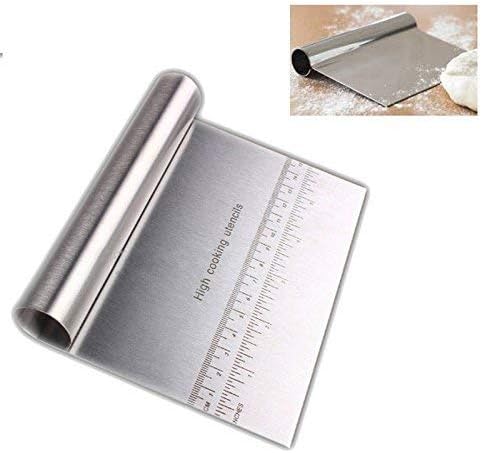
Stainless steel dough scraper, $5.99
5. Add your toppings. Top the pizza dough with the tomato sauce, then the grated pecorino, followed by the grated mozzarella. Layer the pickled onions evenly over the mozzarella. Turn off the broiler, then gently slide the pizza onto the pizza stone. Close the oven door and change the oven setting to bake at 550°F. Bake for 5 minutes, until the rim is golden brown.

6. Broil, drizzle and serve. Change the oven setting from bake to broil and let the pizza cook until the cheese is melted and the crust is golden with spots of brown and a few small spots of char, about 1 more minute. Use tongs or a fork to slide the pizza from the pizza steel or stone onto a large plate. Top the hot pizza with a layering of the coppa and then drizzle lightly with honey. Serve whole or sliced with chili flakes as a condiment.

Saturday Pizza Dough
(Makes 3 regular or 5 thin-crust dough balls)
Sample schedule: Mix the dough at 9 a.m., knead it at 9:20 a.m., shape it into dough balls at 11 a.m., make pizza between 5 p.m. and 9 p.m. For next day pizza, refrigerate the dough balls 4 hours after they are made up, then leave them out at room temperature for 1 hour before making pizza.
Ingredients:
- 350 grams (1 ½ cups) water
- 15 grams (2 ¾ teaspoon) fine sea salt
- 0.3 grams (⅓ of ¼ teaspoon) instant dried yeast
- 500 grams (scant 4 cups) white flour, preferably 00
Directions:
1. Measure and combine the ingredients. Using your digital scale, measure out 350 grams of water (between 90 and 95 degrees Fahrenheit) into a 6-quart dough tub. Measure 15 grams of fine sea salt, add it to the water, and stir or swish it around in the tub until it is dissolved. Measure 0.3 gram (about ⅓ of ¼ teaspoon) of instant dried yeast. Add the yeast to the water, let it rest there for a minute to hydrate, then swish it around until it is dissolved. Add 500 grams of flour (preferably 00) to the water-salt-yeast mixture.
2. Mix the dough. Mix by hand, first by stirring your hand around inside the dough tub to integrate the flour, water, salt and yeast into a single mass of dough. Using a pincer-like grip with your thumb and forefinger, squeeze big chunks of dough, tightening your grip to cut through the dough, alternating with folding the dough to develop it back into a unified mass. Continue for 30 seconds to 1 minute. The target dough temperature at the end of the mix is 80 degrees Fahrenheit; use a probe thermometer to check it.
3. Knead and let rise. Let the dough rest for 20 minutes, then knead it on a work surface with a very light dusting of flour for about 30 seconds to 1 minute. The skin of the dough should be very smooth. Place the dough ball seam side down in the lightly oiled dough tub. Cover with a tight-fitting lid. Hold the dough for 2 hours at room temperature (assuming 70 to 74 degrees Fahrenheit) for the first rise. This timeline is flexible, so if you need to do this after 1 hour or 1 ½ hours, don’t stress, just make up your dough balls a little early and add the difference in time to the next stage.
4. Shape the dough. Divide the dough and shape it into dough balls. Moderately flour a work surface about 2 feet wide. With floured hands, gently ease the dough out of the tub. With your hands still floured, pick up the dough and ease it back down onto the work surface in a somewhat even shape. Dust the entire top of the dough with flour, then cut it into 3 or 5 equal-sized pieces, depending on the style of pizza. Use your scale to get evenly sized dough balls. Shape each piece of dough into a medium-tight round, working gently and being careful not to tear the dough.
5. Second fermentation. Place the dough balls on lightly floured dinner plates or a baking sheet, leaving space between them to allow for expansion. Lightly flour the tops and cover airtight with plastic wrap, and let rest at room temperature for 6 hours for the second fermentation. Alternatively, you can rest the dough balls for 4 hours at room temperature, and then refrigerate to hold for up to the next evening.
6. Make pizza. Without refrigeration, the dough balls can be used anytime in the 4 hours following the second fermentation. If you refrigerated the dough balls, let them come to room temperature for an hour while you preheat the oven and prepare your toppings.
All prices and savings listed in this post are as of publication and could change. Patch may earn a commission on some purchased items.
Get more local news delivered straight to your inbox. Sign up for free Patch newsletters and alerts.